
Berserk Warriors
'Live It Up – The Mental As Anything Story'

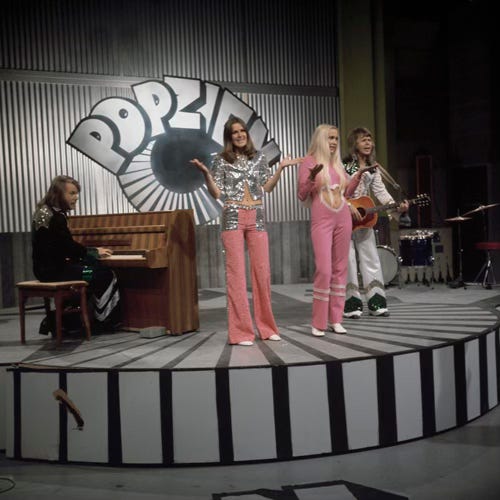
“Mutilation. Jubilation.” Strange lyrics for a song that got joyously stranger, Mental As Anything’s beautiful ‘Berserk Warriors’.
The song blended Boys Own Viking imagery with a rhythmic base that sounded like swords thumping against wooden shields riding along with flickers of surf-rock guitar. It told the story of the relationship breakup of Anna [Agnetha] and Bjorn of ABBA, one half of the preeminent pop quartet of the late 1970s and early 1980s.
If they ever heard ‘Berserk Warriors’, I am sure ABBA would have appreciated Mental As Anything’s oddly seductive tune for the admiration it so wittily evoked.
Australia was the first overseas territory to embrace the Swedish musical phenomenon before they conquered the rest of the world. So it felt right that a group of art-shamans from the cargo-cult village that was inner city Sydney should honour ABBA by consigning them to the gods of melody and historical romance.
Martin Plaza approached the song’s absurdist lyrics and double entendres with a Roy Orbison quiver, singing it straight and true, balancing the humour with heartbreak till it felt entirely noble: a paradoxical equation that often defined Mental As Anything as a band.
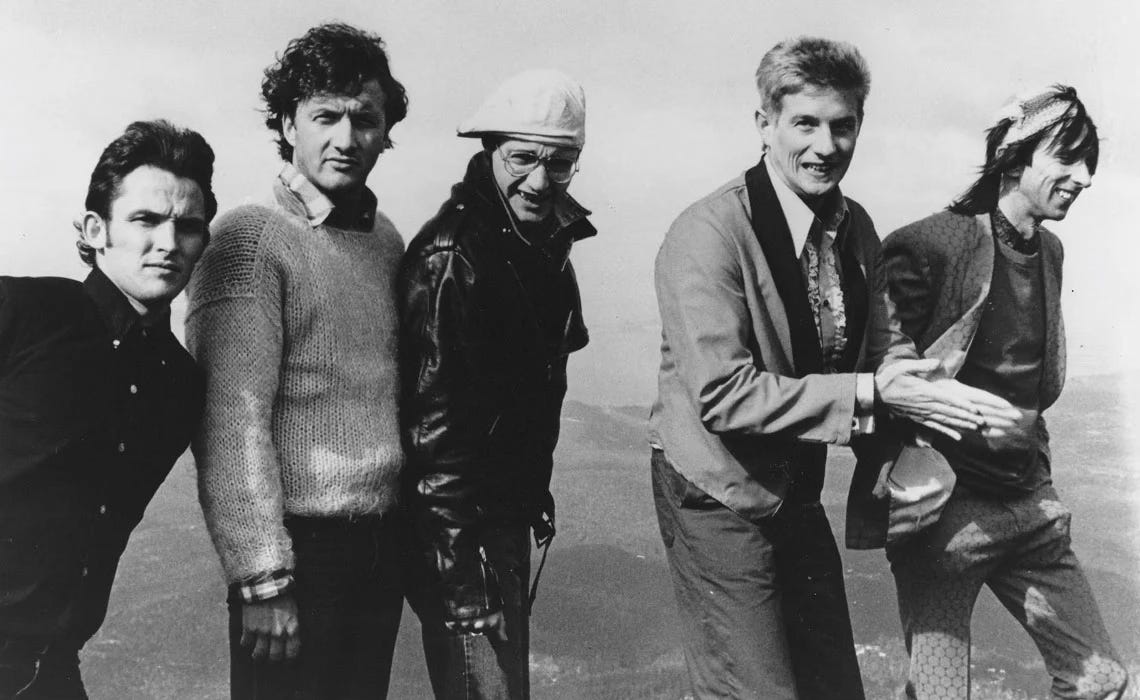
A close look at ‘the Mentals’ reveals they were always singing us up out of any troubles. And this is what a new documentary called Live It Up – The Mental As Anything Story delivers once again in spades.
For most of the film you can’t stop smiling, laughing and tapping your foot, the band’s best songs invincibly catchy or ear-worm quirky, their TV interviews subversively modest and quickfire funny. When the documentary ends there’s an aftertaste of nostalgia and melancholy, like catching up with an eccentric old friend you have loved seeing, knowing it’s unlikely you will meet their like again.
Director Matthew Walker makes use of the band’s brilliant DIY video-clips, rare live footage and old photos that have been hand-coloured in Pop Art pinks and blues along with animated doodles, anamorphic creatures and rocket-ships painted by the band guitarist (and now very famous artist) Chris O’Doherty AKA Reg Mombassa.
The lo-fi aesthetic also owes a lot to fellow artist and friend Paul Worstead, whose iconic posters and album artwork set an early tone for the band. Worstead was responsible for giving the young group their name when they scored their first gig and it was left to him to sort out a poster. Years later he and Mombassa would get a second life providing designs for the iconic clothing label Mambo along with artists on the same wavelength like Martin Sharp, Gary Shead and David McKay.
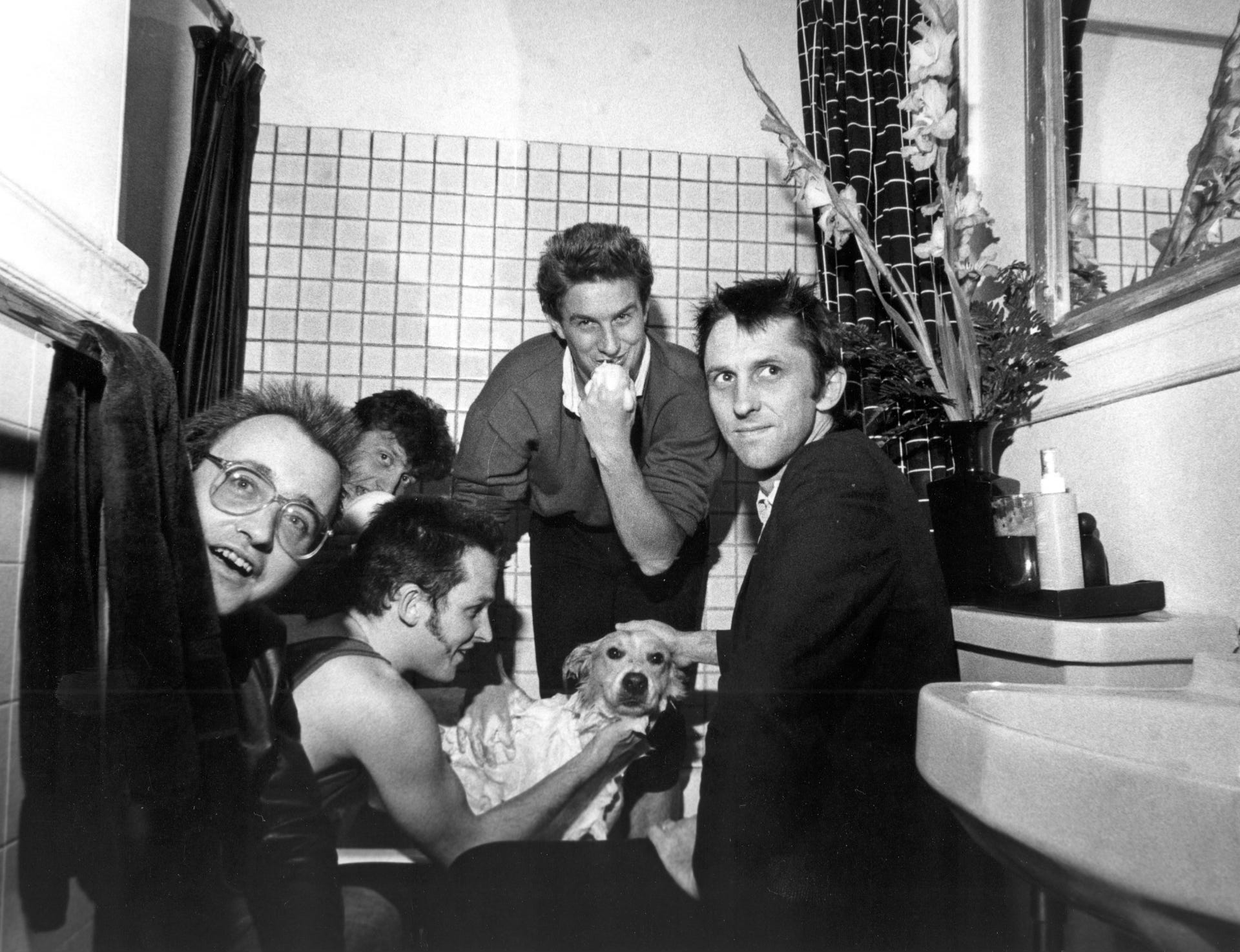
As the film details, Mental As Anything established themselves with what became a residency using the top of a pool table for a stage at the Unicorn Hotel in 1978. They spent their next year at what was then the punk-capital of the city, the Civic Hotel. Jovial misfits in a sea of spikes and rage, they won their audience over and created a whole new one as well.
Some heartbeat in the story tells you this was when the band were arguably at their greatest and probably their happiest too. To quote the title of one of their best known songs, ‘Spirit Got Lost’ later on. It’s a classic rock ‘n’ roll story, though this one has a typically Mentals curve towards warmer recognitions, failure itself a kind of get-out-of-jail card “free” when things went wrong in the 1990s.
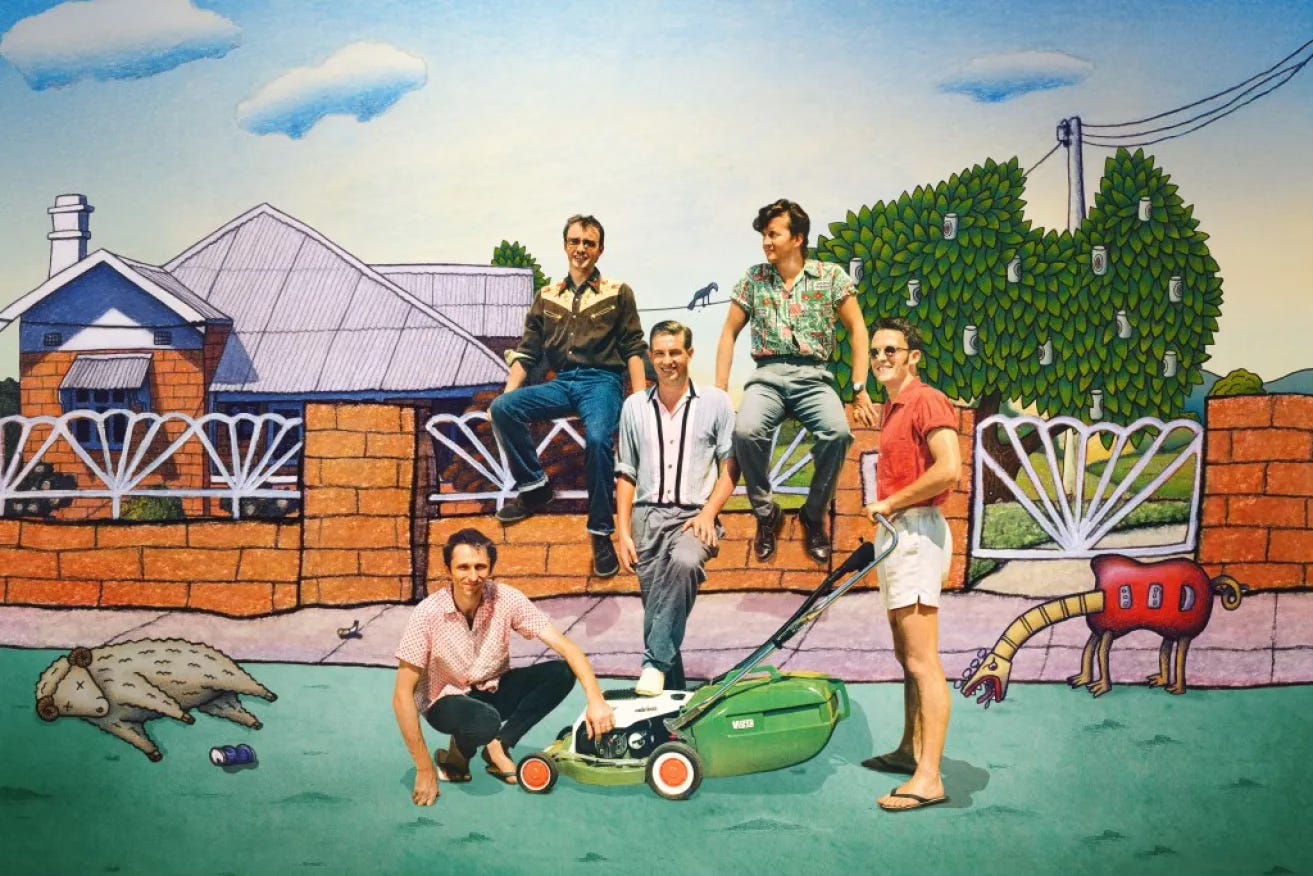
The group started life as an unruly collective of 1970s art-school students based around the sandstone walls of a former colonial prison, East Sydney Technical College in Sydney’s Darlinghurst. Goofy to the point of trippy, they cultivated an aesthetic that mixed a fondness for Hawaiian shirts and op-shop golf pants, a fetish for Victa lawnmowers and a love of alcohol shots (‘The Nips Are Getting Bigger’) into a style that was all their own, springing from some bizarro suburban kitchen to seize the national imagination.
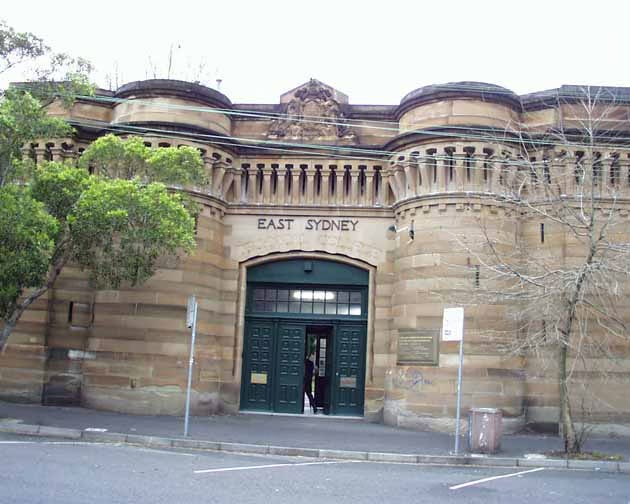
It’s no small irony that two of the main songwriters – guitarist-singer ‘Reg’ and his melodically gifted bassist brother Peter O’Doherty, the tunesmith and lyricist behind ‘Berserk Warriors’ – came from New Zealand. Maybe their dislocated sensibility explains a little of the wonky perspective that the entire band shared.
I always thought of them as a local equivalent to Madness in the UK and The Monkees in the USA. Perfectly formed for and from Australia. Doomed to be at cross-purposes with a music industry incapable of understanding what made them so original – let alone able to accept a group that came bursting out-of-the-box with what were soon to be four unique songwriters and three very different front-people taking turns at the microphone.
If you tried to map the cultural flow they were a part of, you might identify a history from early 1970s bands like Daddy Cool through to Skyhooks and Mental As Anything’s r ’n’ b pop contemporaries The Sports, onwards to later acts as varied as Men at Work, Crowded House, Custard, and even the beginnings of The Wiggles. Is there such a music genre as ‘alt-joy’? Is Oz Pop truer to who we are as a nation than Oz Rock? The Mentals had something in their bloodstream that said ‘yes’.
Musically it meant a band in love with classic AM radio staples and country and surf music, as well as Sun-sessions Elvis rock ‘n’ roll. But Mental As Anything had another echo-chamber to them that was 1960s hallucinogenic and hippie-punk bohemian. Art-school clever, but never cynical, never cold, a signature all their own.
In the documentary, it’s nonetheless a shock to hear they had 25 Top Forty hits across their career, more than any other group in the history of Australian music. Those oddball and funny guys were that successful?
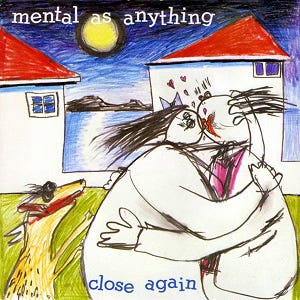
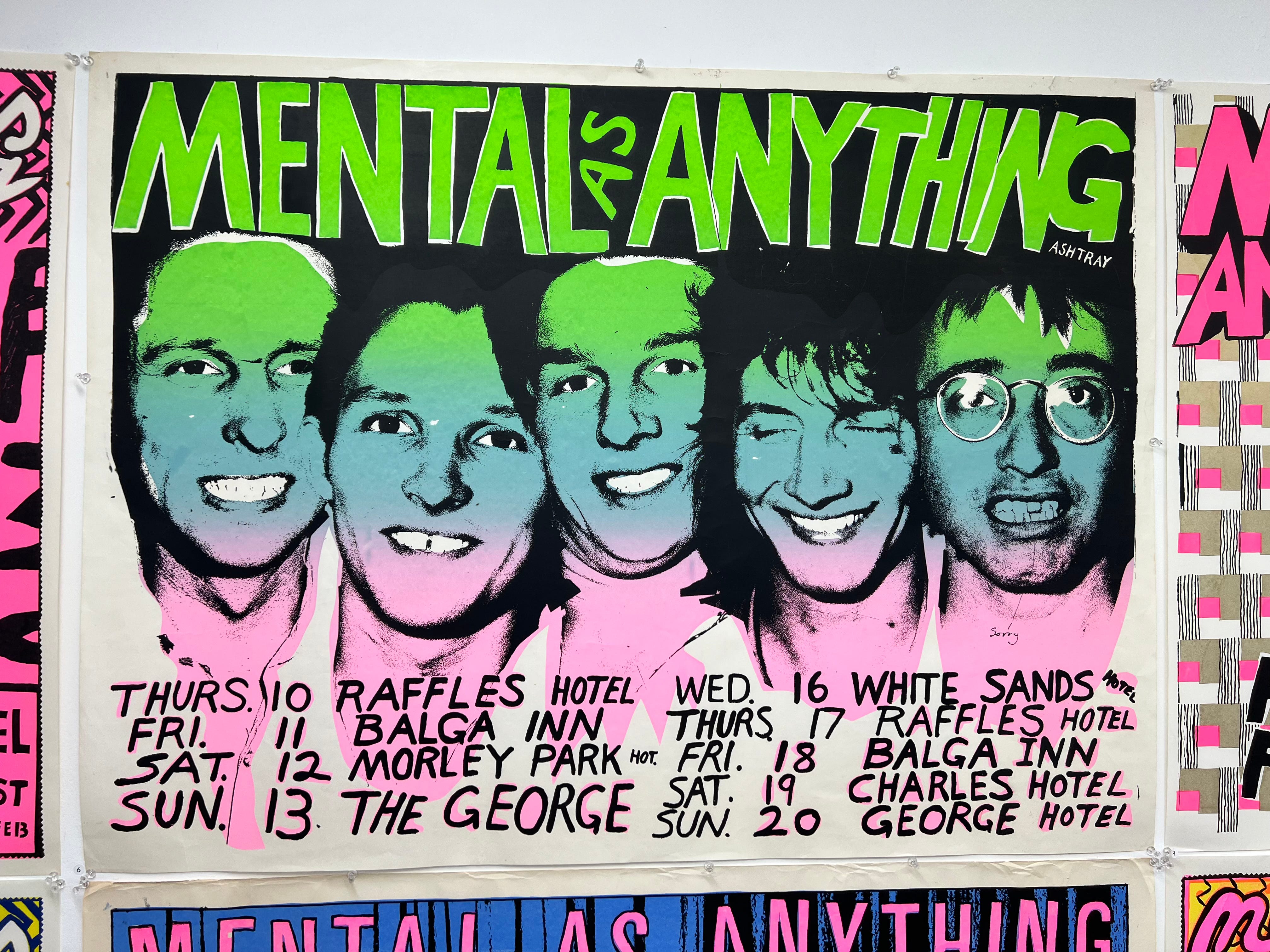
Plaza was the man with golden voice, learning to sing in the shower to hits by Roy Orbison and Elvis Presley. To his surprise as a teenager, Plaza says, he found he could keep up with them. It’s easy to overlook what an impressive voice he had, the Mentals comedic and comic-book presence sometimes obscuring how genuinely talented all of the band were.
As Crowded House’s Neil Finn observes, the Mentals gave off the appearance of not knowing what they were doing while clearly knowing exactly what they were on about. A genius for amateurism that Finn admits to being very impressed by. It’s not too hard to draw a line between the Mentals knockabout live presence and the bright energy that Crowded House would later exude on stage, a tiny debt of inspiration.
Talking heads can be gratuitous and hagiographic, but across the Live It Up documentary Neil Finn, Men at Work’s Colin Hay and Dave Graney definitely help you appreciate the artistry of the band. They cast a heartfelt craftsmen’s eye over the music, making you notice what can so easily pass you by in the Mentals’ nimble mix of jokey singalongs and absurdist colour.
DG speaks about the rare and unimpeachable “wholesomeness” of the Greedy Smith’s iconic song ‘Live It Up’. Hay dives into the same song as a portrait of Greedy at his generous best, reaching out as he always did to help anyone who was feeling down. Hay smiles at the memory of Greedy in this real-life mode and simply says, “My man. My man.”
It’s a moment that almost pulls a tear from you. But the documentary keeps moving along, the narrative packed with the usual ups-and-downs that make-and-break a great act. Behind the affectionate vision you see the decline, the crushing into formula and the loss of direction. But there’s an overall absence of bitterness that dominates the frame, while the band’s camaraderie overrules any failures, as if to say Mental as Anything were never truly into the music industry game to begin with.
The unexpected death of Greedy Smith and the illness that forced Martin Plaza to retire from performing are a part of this story in the last decade. By then, Mombassa and O’Doherty and drummer Wayne ‘Bird’ Delisle were long-gone and the Mentals, though still creating new material, were to some extent their own covers act. A lot of this had to do with Greedy, who believed in pleasing the punters, touring the clubs and keeping the band name alive from the year 2000 on. It’s a debt his more perverse and laconic bandmates happily acknowledge.
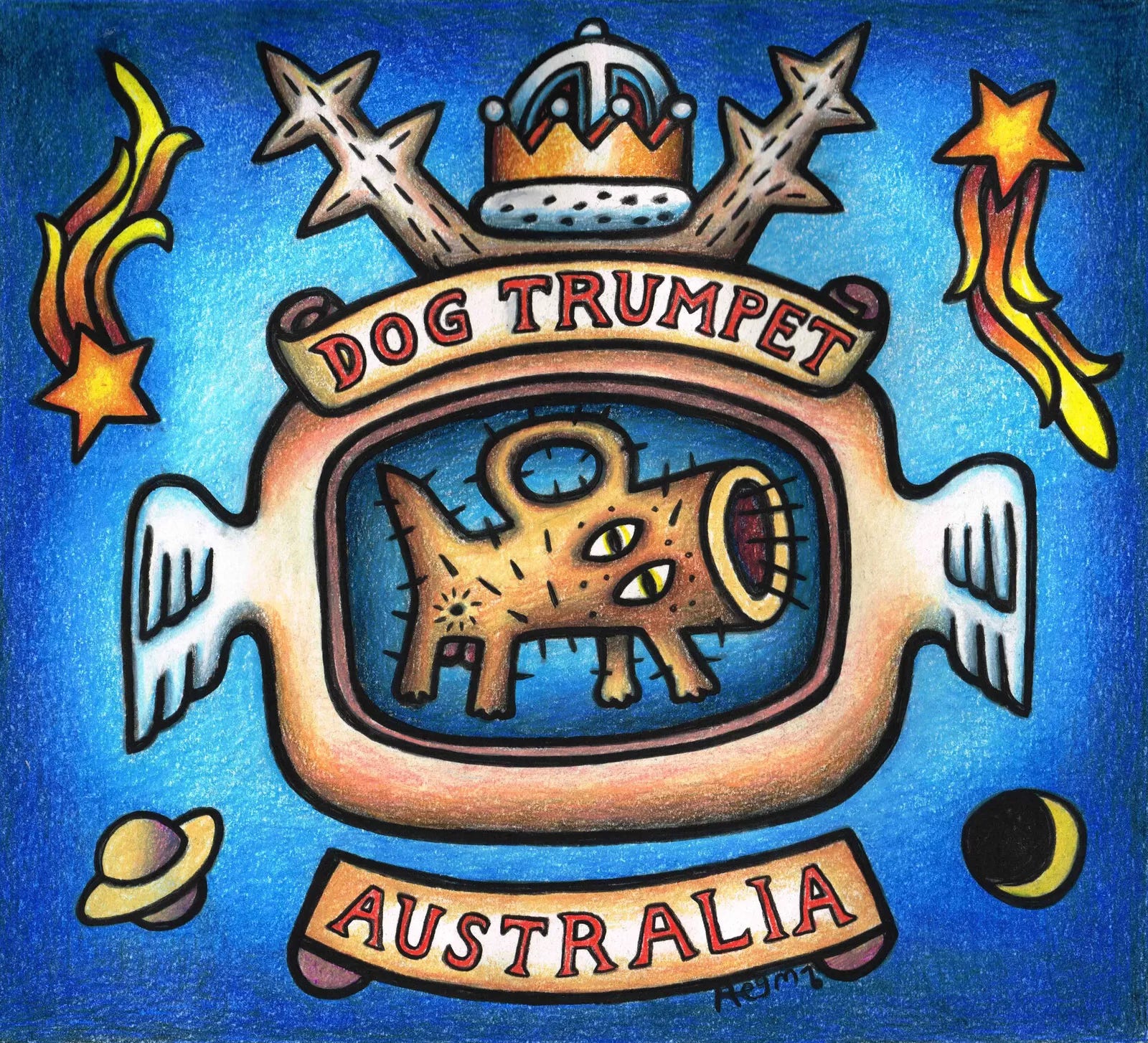
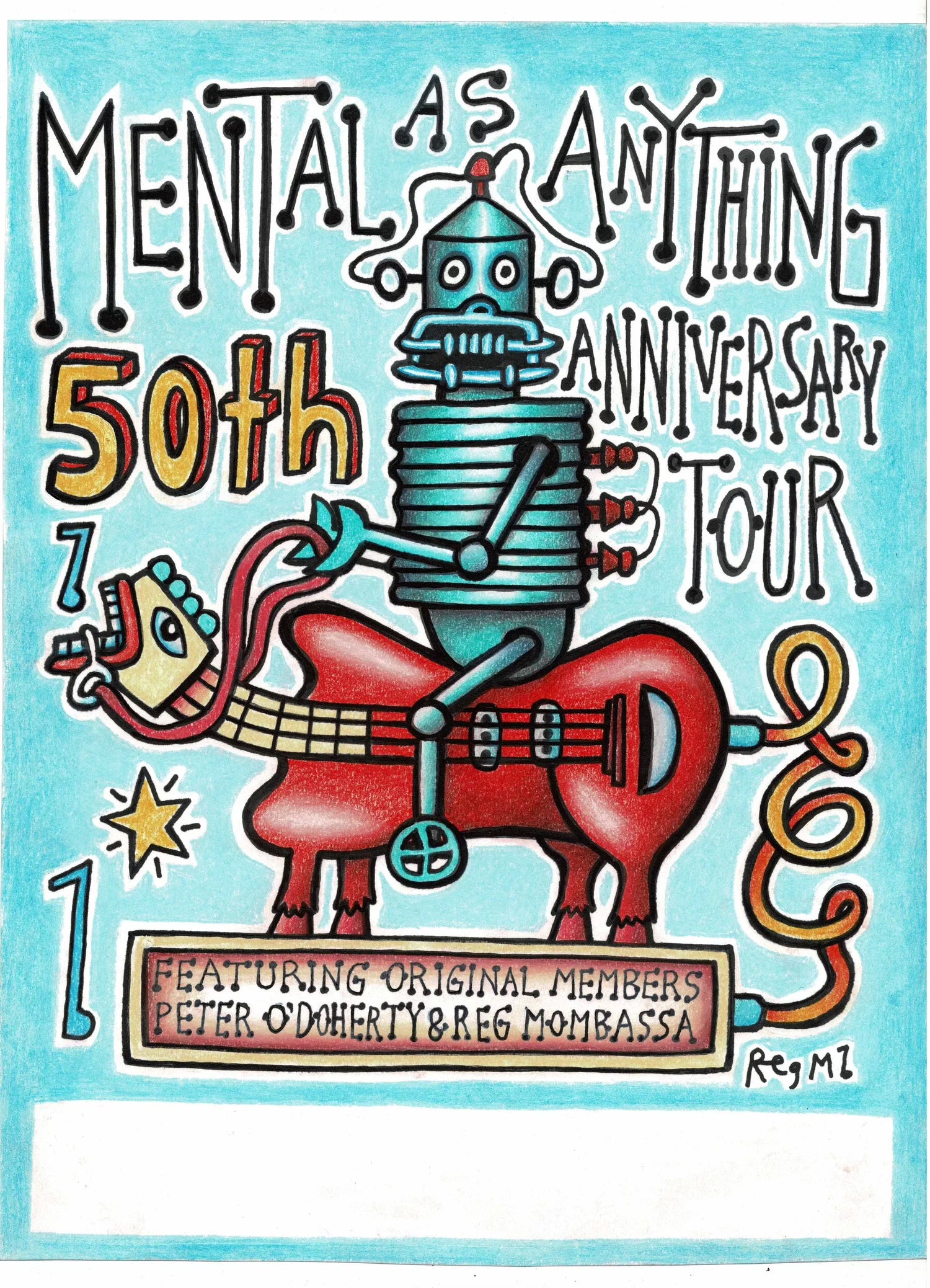
These days Mombassa and O’Doherty are in their own purple patch with the magnificent Dog Trumpet carrying on from the very best that Mental As Anything ever offered. In the wake of the film and an unexpected revival of the song ‘Live It Up’ as a Scottish football anthem in the UK, Mental As Anything have reformed under the two brothers’ guidance for a celebratory 50th anniversary tour. Plaza and Bird are too unwell to join in but have given them their blessing. O’Doherty’s son has stepped in on the drums. The communal and collective spirit prevails.
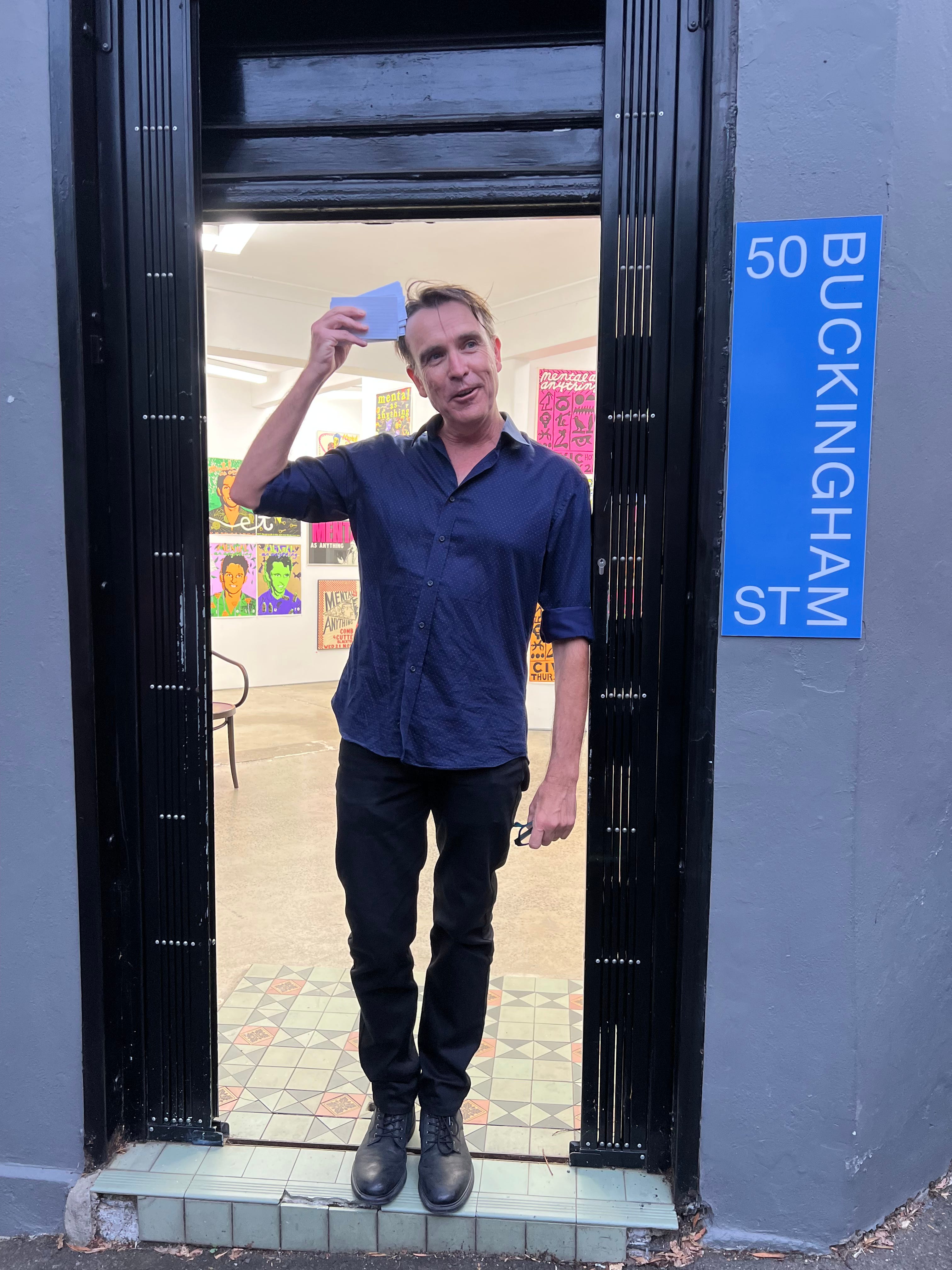
After the premiere in Sydney at the Haydn Orpheum Cinema, there’s a conversation well-handled by the Hoodoo Gurus’ Dave Faulkner. He zeroes in on the song-craft and the deceptive strengths the band had underneath their clowning. This underestimation is a small if persistent thorn, but the brothers can’t help themselves - Reg Mombassa and Peter O’Doherty are soon trading repartee, sharing stupid stories about the band’s members real and outlandish stage names.
That said, they easily handle an audience question about the influence of the early twentieth century Dada art movement on the band’s aesthetic, a space where whimsy and the anarchic (“we had no plans, ever”) held much interest.
Beside them on stage, director Matthew Walker seems rather muted and shy, admitting to being overwhelmed by the heroic company he found himself in during filming. The director’s personality actually makes him the perfect interpreter for the Mentals and how they approached the world: unpretentious, collaborative and open. Walker has certainly done something special with Live it Up, capturing the band’s joyful and surreal energy without looking away from – or capsizing into – the failures and losses.
He also leaves a lot of unstated space in the film for aware viewers to pick up on the band personalities. Reg Mombassa’s avant-garde oddness and quietly steely sense of purpose. Brother Peter O’Doherty’s pop talent and wry sensitivity edged to the point of fragility. Greedy’s relentless and even blind optimism, a salve for a less secure self-image that finally wins out through sheer goodness. Plaza’s obvious stage charisma and mighty voice disguising struggles with anxiety that almost got the better of him. Drummer Bird, an askance Ringo caught between two madly driven sets of Lennon-and-Macartney at some imaginary backyard musical barbecue that could get a bit much to handle.
Live It Up – The Mental As Anything Story is very easy to love and a pleasure to see. It shows what we always knew, that the Mentals were never an obvious act. If their albums suffered from the menagerie of creative talent that made the band what it was, there’s no question they became one of the great Australian singles bands: ‘Live It Up’, ‘Berserk Warriors’, ‘The Nips Are Getting Bigger’, ‘Too Many Times’, ‘If You Leave Me, Can I Come Too?’, ‘Spirit Got Lost’, ‘Come Around’…
Solid gold hits for the heart. Each one made for radio loving.
As the after-film conversation winds down at the premiere, Peter O’Doherty makes a side-on comment about Mental As Anything that has a sting of pride to it in summing up the truth of them: “We were a garage band. And we were a really good one.” Mombassa meanwhile expresses his gratitude for everything that happened and his hopes for Mental As Anything’s music as a small contribution “towards more kindness and compassion in the world”.
M
So many great songs. So much fun. No-one like the Mentals.
“Alt-joy” love it. Wonderful piece - oh to be a 16 year old kid today who chances upon a Mental’s greatest hits CD in an oppy and gets “it”. I was 17 at Monash uni back in 1979. “Nips” was on the airwaves. I was walking around the campus a bit dopey. Some older dude had a bunch of students around him so I craned in to see what the fuss was about. He was handing out free tickets to a gig that night in St Kilda. Obviously Rockpile (Nick Lowe, Dave Edmunds and gang) hadn’t proven a popular draw. I grabbed a handful and rang a few mates and we went. We lobbed early to sink a few VBs. Even with the free tickets, not much of a crowd was on hand. Soon, through the haze, a motley bunch of scraggy rockabilly types drifted on stage. It was the Mentals in support band capacity. Gees they were good. In 45 minutes they turned me and a couple of other kids into life long fans. I was the pub only a few weeks back either one of these mates and that gig was a topic of conversation. The song Berserk Warriors has always been my favourite Mentals song. The Creatures of Leisure album is a suburban romp unparalleled.